
Hacks & Buildsmeshtasticloraopen-hardwaregps
Jon G. Aguado's LIA dog collar tracks a pet over Meshtastic radio with no SIM, and its Beacon mode lights the dog up in the dark
LIA, an open-source collar tracker built on an ESP32-S3, a LoRa radio and a u-blox GPS, sends a pet's position node to node over the Meshtastic mesh, with a three-position switch for Beacon, low-power Tracker and a real hardware off.
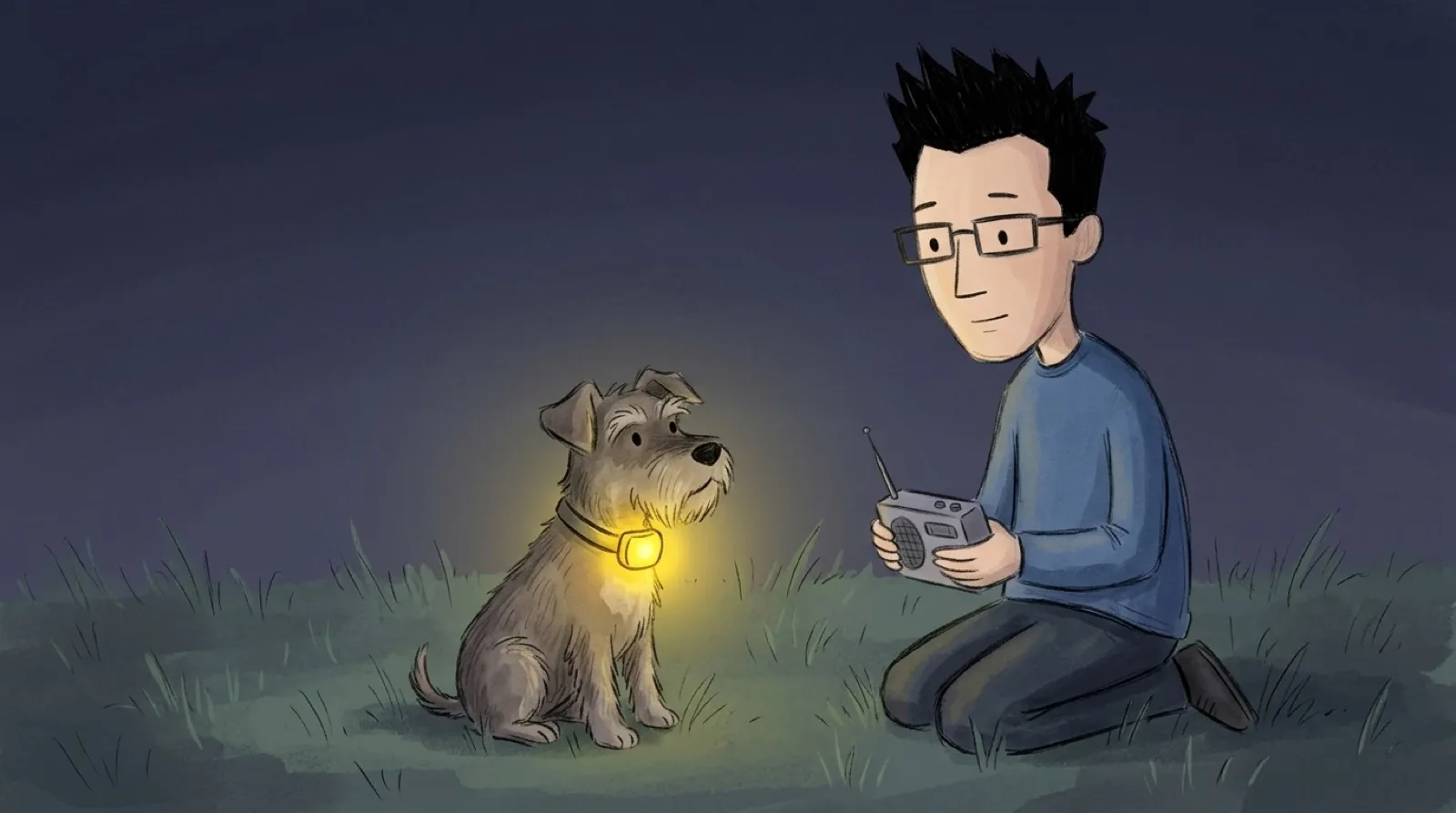
Commercial pet trackers ride on a cell plan or a Bluetooth leash. “Lose signal, stop paying the bill, or wander somewhere off the grid, and the tracker goes dark,” Aguado writes in his Instructables build guide. LIA swaps the carrier for Meshtastic, the open LoRa mesh that hobbyists already run on rooftops and backpacks.
The loop is five steps, and the project site lists them like a recipe: wake, get a GNSS fix, broadcast over LoRa, let nearby nodes relay it “toward a gateway, node by node,” then power the radio and GPS down and go back to deep sleep.
The switch on the side decides how hard that loop runs. HIGH is Beacon mode: “LED solid red, never sleeps, broadcasts every 30 seconds,” the guide says, built for “where did the dog just go.” LOW is Tracker mode, which wakes “roughly once a minute,” sends a fix and sleeps again. OFF “cuts power to the MCU entirely while still letting the battery charge.”
The red light is expensive. On the 3,500 mAh 18650 version, Tracker mode runs “roughly 3.3 days,” against “~4 hours in Beacon mode,” and Aguado’s own math says “the status LED alone eats about 87% of the awake current.” Spotting the dog at night costs most of the battery, so Beacon is the search mode and Tracker is the everyday one.
The position doesn’t go out to everyone. LIA sends it “only as a direct message to a predefined node,” per the GitHub README, so the rest of the mesh can’t map your dog’s walk. You can also text the collar: send GPS, BATTERY or HELP as a direct message and it answers the same way.
Charging goes through a 4-pin magnetic pogo connector, “so once it’s sealed, it stays sealed.” The FAQ is honest about what sealed means today, though. “The enclosure is still under design,” it says, with a gasket seal planned for future revisions.
Play the video on YouTubeThe build log keeps the mistakes in. The first boards came back with the IMU’s I2C lines “crossed as manufactured,” fixed with two jumper wires and hot glue, and the guide promises a history that includes “a ‘dead battery’ that turned out to just be a dead battery.” What it can’t fix in firmware is the map: LIA only reaches you “where there’s LoRa mesh coverage,” and in a valley with no nodes, the FAQ says, it “can still log GPS fixes locally, but it can’t relay them anywhere.”
Expect more “the network is your neighbors” hardware. Once a few nodes cover a town, anything small and battery-powered can report through them for free: bikes, cattle, a kid’s backpack on a hiking trip. The catch moves from the monthly bill to coverage, and coverage depends on people choosing to put up a node.
Licensing is the next fork. LIA ships under CC BY-NC-SA 4.0, and the FAQ says selling units you build needs permission, so the first company that wants to sell a mesh collar either strikes a deal or starts from scratch. The project’s own repo already has a mobile/ folder for a companion app, marked “planned.”