
Hacks & Buildsroboticsandroidarduinoopen-source
OpenBot Turns an Android Phone Into the Brain of a $50 Robot Car
OpenBot, an MIT-licensed project that began at Intel Labs, pairs a roughly $50 wheeled body and an Arduino with an Android phone that does the seeing, thinking and driving.
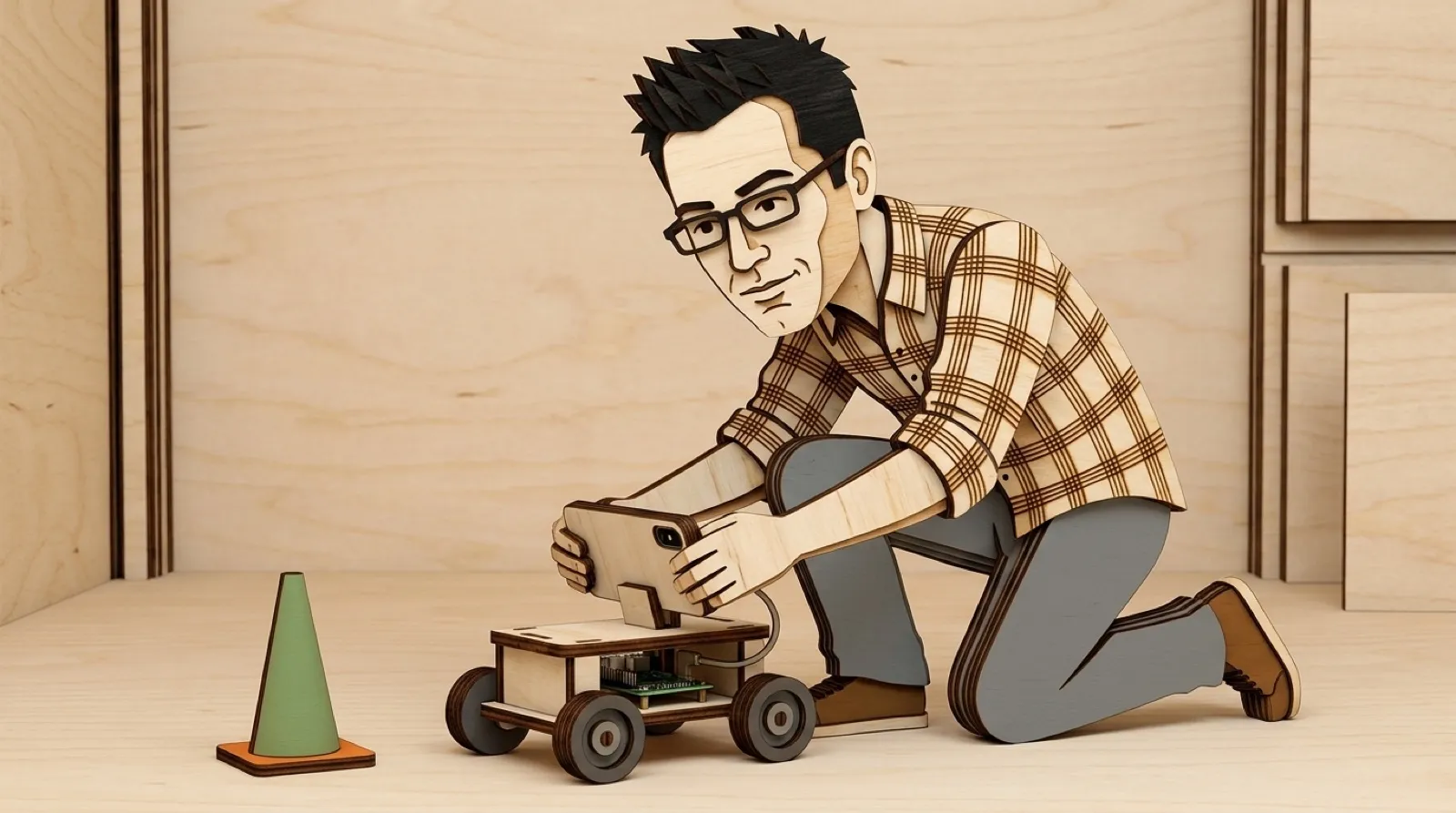
The pitch fits in the project’s README: “OpenBot leverages smartphones as brains for low-cost robots. We have designed a small electric vehicle that costs about $50 and serves as a robot body.”
Müller and Koltun’s paper framed it as a fix for a gap in research robots: “Current robots are either expensive or make significant compromises on sensory richness, computational power, and communication capabilities.” Their answer: “We design a small electric vehicle that costs $50 and serves as a robot body for standard Android smartphones.” The paper reports that “controlled experiments demonstrate that the presented approach is robust across different smartphones and robot bodies.”
The division of labor is pretty much what you’d want if you’ve ever fought with a robot kit. Per the firmware docs, “the MCU receives the vehicle controls and indicator signals via the serial connection. It converts the controls to PWM signals for the motor controller and toggles the LEDs according to the indicator signal.” The phone thinks, the Arduino drives the wheels, and a USB cable sits between them. There’s even a “no phone mode” for testing the car before you trust it with your handset, where it drives itself and slows down as an ultrasonic sensor sees obstacles.
Play the video on YouTubeWhen IEEE Spectrum covered the launch in October 2020, Müller was at Intel Labs and made the case on the phone’s behalf. “Smartphones have become extremely powerful and feature dedicated AI processors in addition to CPUs and GPUs,” he told robotics editor Evan Ackerman. “Almost everyone owns a very capable smartphone now.” Spectrum reported the stack had been tested on 10 recent Android phones, and pointed out the idea wasn’t new: Romotive’s $150 Romo did a phone robot back in 2012 and 2013, a chassis that took one of three iPhone models.
Spectrum also asked why OpenBot skipped ROS, the standard robotics middleware. Müller said ROS “adds unnecessary overhead,” though “if someone insists on using ROS with OpenBot, it should not be very difficult.” The bigger worry in that piece was whether the project would last. “We are committed to the OpenBot project and will do our best to maintain it,” Müller said, pointing to the group’s other long-running projects such as CARLA and Open3D.
The body comes in several flavors now. The body README lists a “3D-printed body” that “relies on low-cost, readily available hobby hardware,” an OpenBot Lite “developed for education,” a shell for 1 RC trucks and a multi-terrain vehicle. The October 2020 article also mentioned Intel was working on a “bigger, faster and more powerful robot body that will be suitable for mass production.” Whether that body ever shipped isn’t something the repository says.
Phone-as-robot projects keep coming back because phone hardware keeps getting better while the parts around it stay cheap. Romo bet on three specific iPhones and the novelty wore off; OpenBot bet on any recent Android, open code and a body you print yourself. A drawer full of retired phones is a lot of idle cameras and processors, and each new phone generation adds to that drawer.