
Hardwareroboticsorigami-roboticsdata-glovesphysical-ai
Origami Robotics' S1 Glove Reads 20 Finger Joints So Its Matching Robot Hand Can Copy Each One Directly
Origami Robotics built its S1 data glove with the same joint layout as its robot hand, so every finger angle a person makes becomes a target for the matching robot joint, and it says mass production has started.
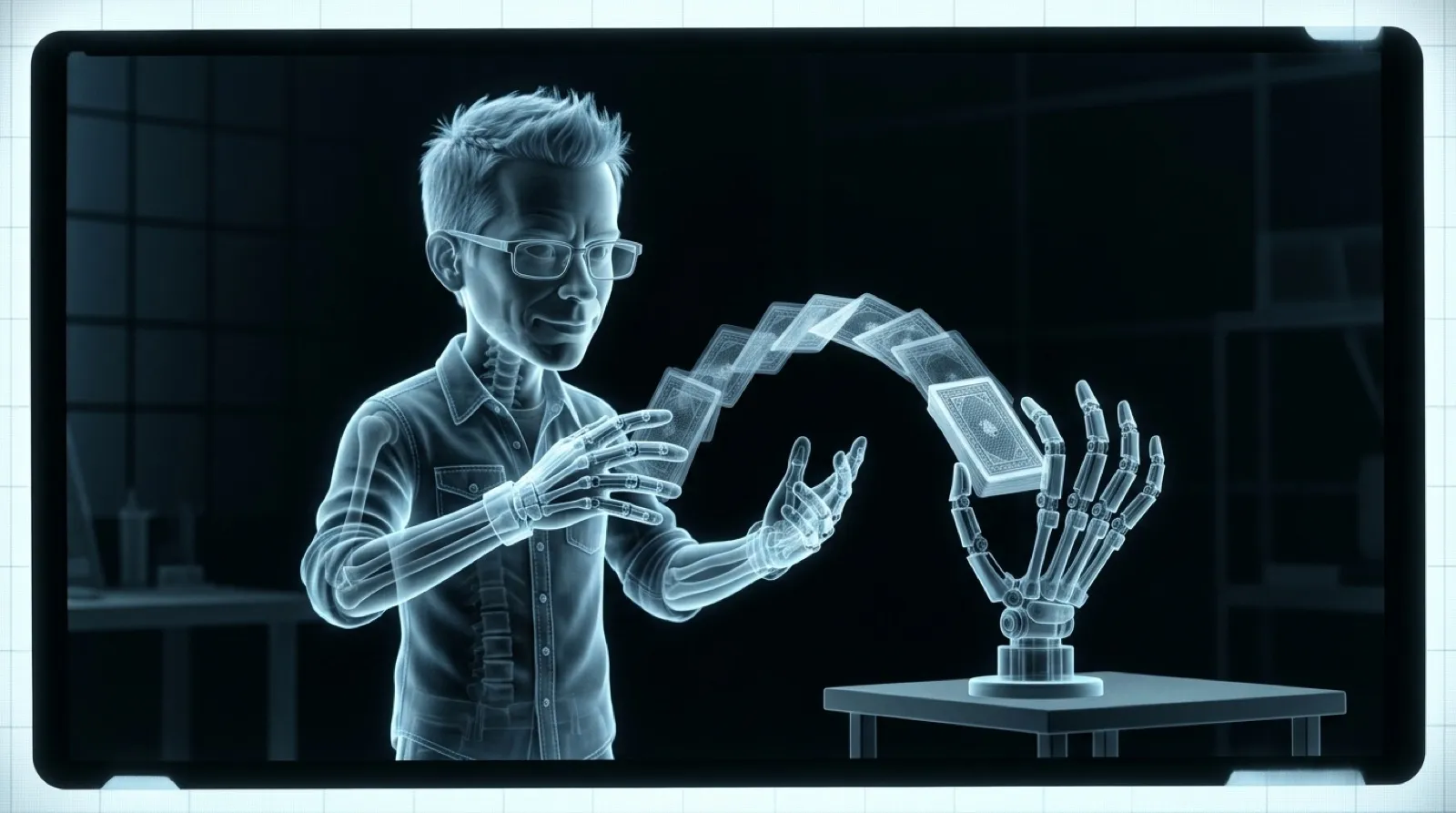
Origami Robotics wants to teach robots with your hands, not with your YouTube history. “Imagine watching a million hours of video to learn the violin without ever practicing,” the company wrote in a post on its blog introducing the glove.
The S1 is its answer to that problem. “We directly record 20 finger joint angles using joint encoders,” the post says, and it measures “pressure at the fingertips and palm” alongside video from a wrist-mounted global-shutter camera, all on one shared timeline.
The trick is in the robot on the other end. “We gave the glove and robot hand the same joint arrangement,” Origami wrote. “Each measured glove angle becomes a position target for the corresponding robot joint.” No model has to guess where a knuckle went from a blurry frame. The glove just tells the hand.
That matters most when the camera can’t see. Origami recorded hands working inside a container and reported that “under full occlusion, the vision pipelines sometimes lose the hand estimate entirely,” while the encoders kept reading. It ran the glove through 30 tasks, “including fast Rubik’s Cube solves, card shuffling, and butterfly-knife tricks.”
This isn’t the first version. “We built an earlier version of the glove seven months ago and deployed it in a couple of factories,” the company wrote, and the rigid shell didn’t fit everyone: “Their hands were different sizes, and the shell left too little room to accommodate them.” The S1 moved to a softer design, though “each new wearer still fits and calibrates the glove before recording.”
Origami is a small shop run by brothers. “Hi, We are Daniel and Ryan,” begins their Y Combinator launch post, written by Ryan Xie, which says Daniel studied robot manipulation at Carnegie Mellon’s Robotics Institute and that “We already sold our hands to Physical AI Labs like Amazon.” Humanoids Daily noted the launch has a waitlist instead of a price tag.
The company’s own fine print is the part still open. “The natural speed and dexterity of these movements remain difficult for robotic hands to reproduce,” Origami wrote. The glove can record a butterfly-knife flip. Nobody has shown the hand doing one.
| Origami S1 | Manus Metagloves Pro | Rokoko Smartgloves II | |
|---|---|---|---|
| How it reads fingers | Joint encoders | Electromagnetic field tracking | IMU plus electromagnetic sensor fusion |
| Finger data | 20 joint angles | 25 degrees of freedom | 7 sensors per glove |
| Touch sensing | Fingertip and palm pressure | None listed on the product page | None listed |
| Built-in camera | Wrist-mounted global shutter | None listed | None listed |
| Maps to a specific robot hand | Yes, Origami’s own, joint for joint | No | No |
| Price | Not published; request access | Request a quote | Not on the product page |
Figures come from each maker’s own page: Origami, Manus, Rokoko. Manus pitches its glove for “robotics training, motion science, and AI research” too, so Origami isn’t alone in the market. It is alone in shipping a glove built as the mirror of one particular hand.
Robot-hand makers are likely to start selling the data rig and the hand as a matched pair, because a glove that speaks one hand’s joint language makes every recording worth more to that hand and less to anyone else’s. Expect the next round of announcements to brag about hours recorded, not just joints counted, and expect someone to ask what a glove-trained hand does when the human it learned from had bigger fingers.