
A homemade Tesla charging robot grabs the car with suction cups to push its plug in
The home-built robot borrows the car’s body for the force needed to insert a charging connector.
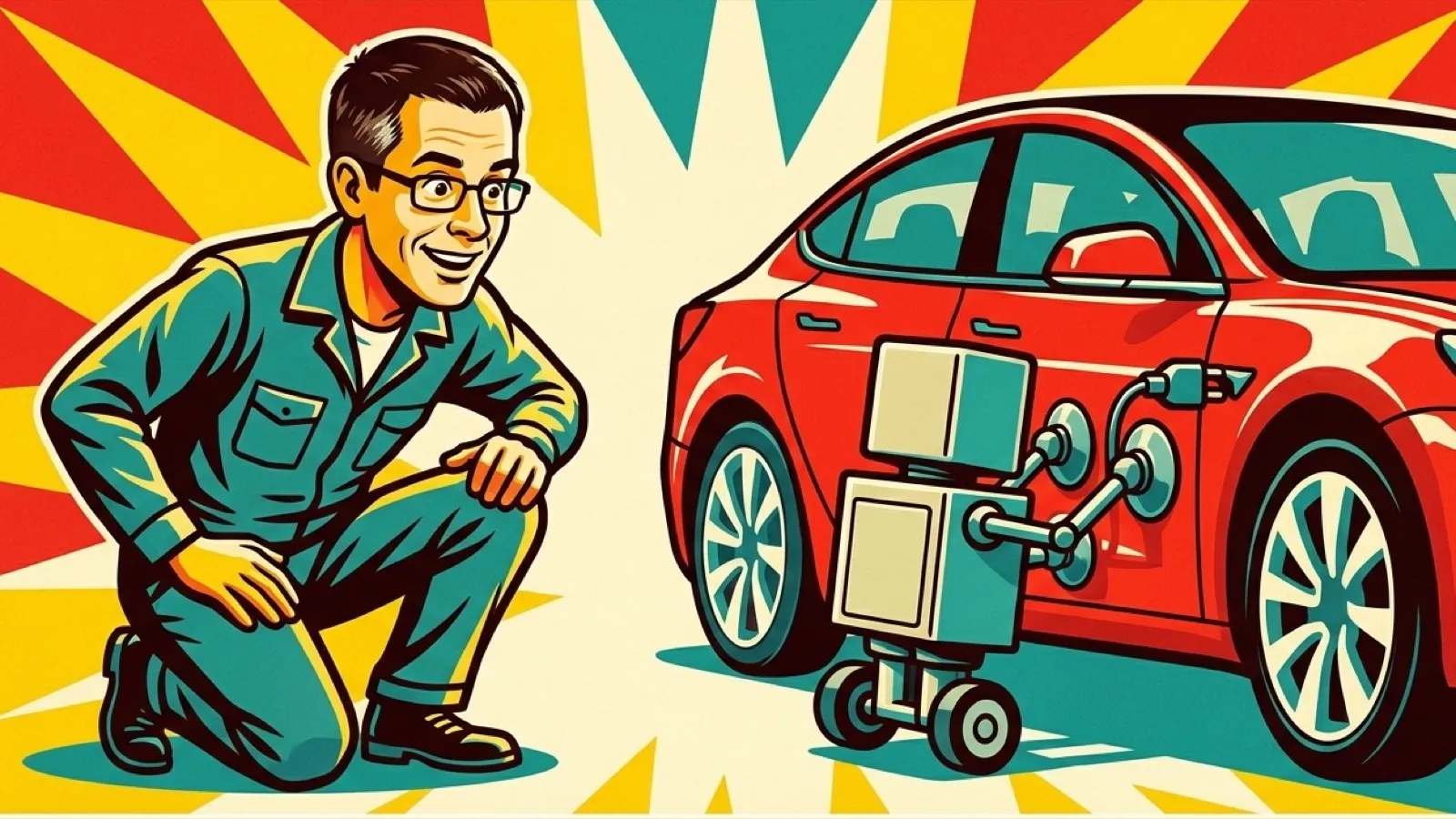
Plugging in a car is easy when you have feet, body weight and a reasonable idea where your hand is. A small robot has to replace all three advantages. This charging build uses suction cups to borrow support from the car itself, which is an unusually literal way to lean on your vehicle.
The project repository targets a 2021 Tesla Model 3. Its builder wanted most of the robot to remain under the car during charging, with the cable descending toward the floor. A large heavy base could resist insertion force, but it would also occupy the space beside the car the builder wanted to keep clear.
The suction cups supply that resisting force at the panel around the port. The pump’s electrical current provides another signal: the maker says current drops when a proper vacuum forms. That lets the control system use an observation from the gripping mechanism alongside its camera-based estimate of alignment.
Play the video on YouTubeThe camera needs more than the port’s approximate location. Inserting a connector requires its position and orientation to agree with the socket. The builder reports that a single AprilTag left too much pose uncertainty, then switched to a ChArUco target for more stable alignment. That is a specific change to the visual reference, rather than another identical attempt with the same uncertain estimate.
Travel through the garage is deliberately simpler. The project describes roughly two meters of movement, with predefined motion and lidar readings getting the machine into position before camera alignment takes over. It does not use SLAM. A constrained route can avoid solving the much larger problem of navigating arbitrary spaces (the garage has declined to become a research campus).
A Raspberry Pi 5 and an ESP32-C3 on a custom board handle the electronics. The Raspberry Pi 5 is only one component of a mechanical and electrical build, with CAD and board details supplied in the repository. There is no basis here to treat it as an off-the-shelf charging accessory.
The car integration uses the paid Tessie API. The maker checks that the car is home, parked and disconnected, alongside lidar and geofence information, before attempting the automatic connection. Those conditions show how much context the machine needs before the visible act of moving the plug can begin.
The account is one maker’s implementation, with no reliability or vehicle test repeated here. Its most memorable decision solves a very physical constraint: a small machine needs something to push against. The camera helps find the target, the current sensor helps confirm the grip, and the suction cups let the parked car supply some of the robot’s missing stance.
The car is helping plug itself in.