
Infrastructurewifitech-historyradio-astronomycsiro
Wi-Fi Grew Out of CSIRO Radio Astronomer John O'Sullivan's Search for Exploding Black Holes
He never found the black holes Stephen Hawking predicted, but the Fourier transform work behind the search became the 1990s CSIRO fix for radio echoes indoors, patented in the US in 1996 and now in more than five billion devices.
In 1974 Stephen Hawking predicted that small black holes should eventually explode, and that the blast would give off radio waves. A young Australian radio astronomer named John O’Sullivan went looking for them.
“John didn’t find them,” says the 2009 release for his Prime Minister’s Prize for Science. The techniques he sharpened while looking ended up in your router.
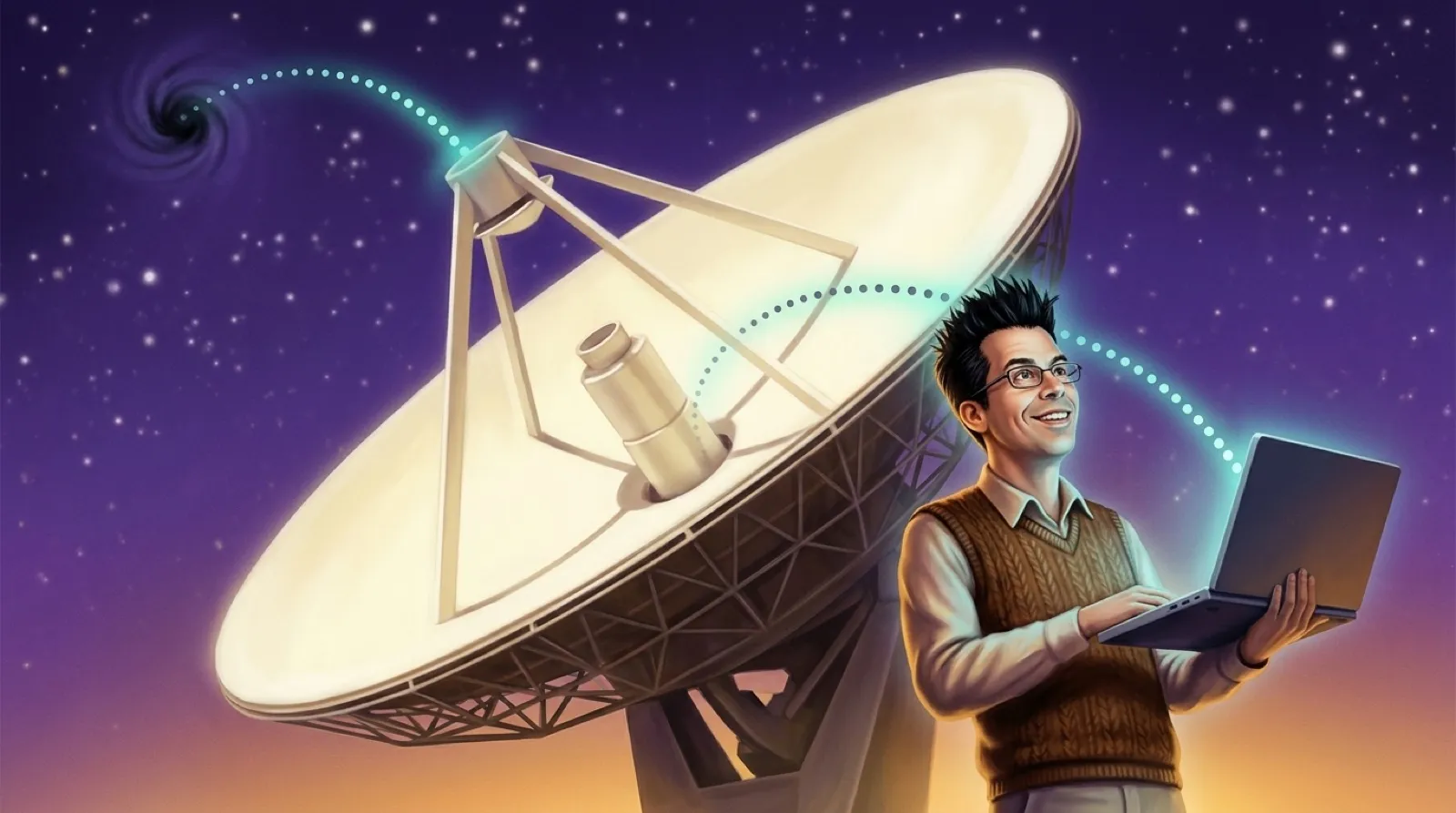
After his doctorate, O’Sullivan “set off in 1974 to work for a year on the Westerbork radio telescope in The Netherlands.” The search for Hawking’s black holes was part of that work, and “Fourier transforms were the key to his work.” A Fourier transform takes a messy signal and breaks it into the frequencies inside it. Doing that fast, on a lot of data, was the hard part.
So he got hardware made. “To simplify and speed up the transform task he worked with Austek Microsystems” on a chip with “160,000 transistors” that ran at “rates up to 2.5 Msamples/s.” The astronomer Ron Ekers, quoted in the same release, says “John is unusual in that he likes to work things out from first principles.”
Then the job changed. “By 1990 CSIRO was looking for ways to commercialise its capability in radio physics.” O’Sullivan and colleagues looked at computer networks, which were still all cables. “We realised that our skills with antennas, signal processing, and radio design might allow us to cut the network cable,” he said. “From the beginning we set out to match the speed of the best wired networks of the time.”
The obstacle was the room itself. “In the confines of buildings and rooms, radio waves bounce off many surfaces,” the release explains, “so that a transmission arrives at a receiver followed by a series of echoes.” CSIRO’s own page calls it reverberation, “where radio waves bounce around the surrounding environment causing an echo that distorts the signal.”
The fix came “using the same techniques he’d applied to astronomy.” The 2013 case study says the breakthrough in combating reverberation “came from pioneering work in radio astronomy.”
“Within a year, in 1992, CSIRO applied for an Australian patent,” and “the US patent came in 1996.” The approach went into the IEEE 802.11a standard. CSIRO names the inventors as “Dr John O’Sullivan, Dr Terry Percival, Mr Diet Ostry, Mr Graham Daniels and Mr John Deane,” and estimates the technology is “in more than five billion devices worldwide.” O’Sullivan’s team took the 2009 PM’s Prize, and the European Patent Office gave them its Non-European Inventor Award in 2012.
Getting paid wasn’t quick. The release notes “it took until April 2009 to agree on licensing terms” with the companies using it, seventeen years after the first filing. Nobody has yet detected one of the exploding black holes O’Sullivan went looking for in 1974.