
Tools & Gearwearablesdisplayshardwareresearch
NUS Researchers Wove a Working Touchscreen Into a Garment Sleeve From 1 mm Fibres That Survive 50 Machine Washes
A National University of Singapore team threaded more than 5,000 LED chips into 54 drawn fibres to make a 96-by-54-pixel touch display on a sleeve that ran a calculator, a compass and video, and kept working after 50 detergent washes.
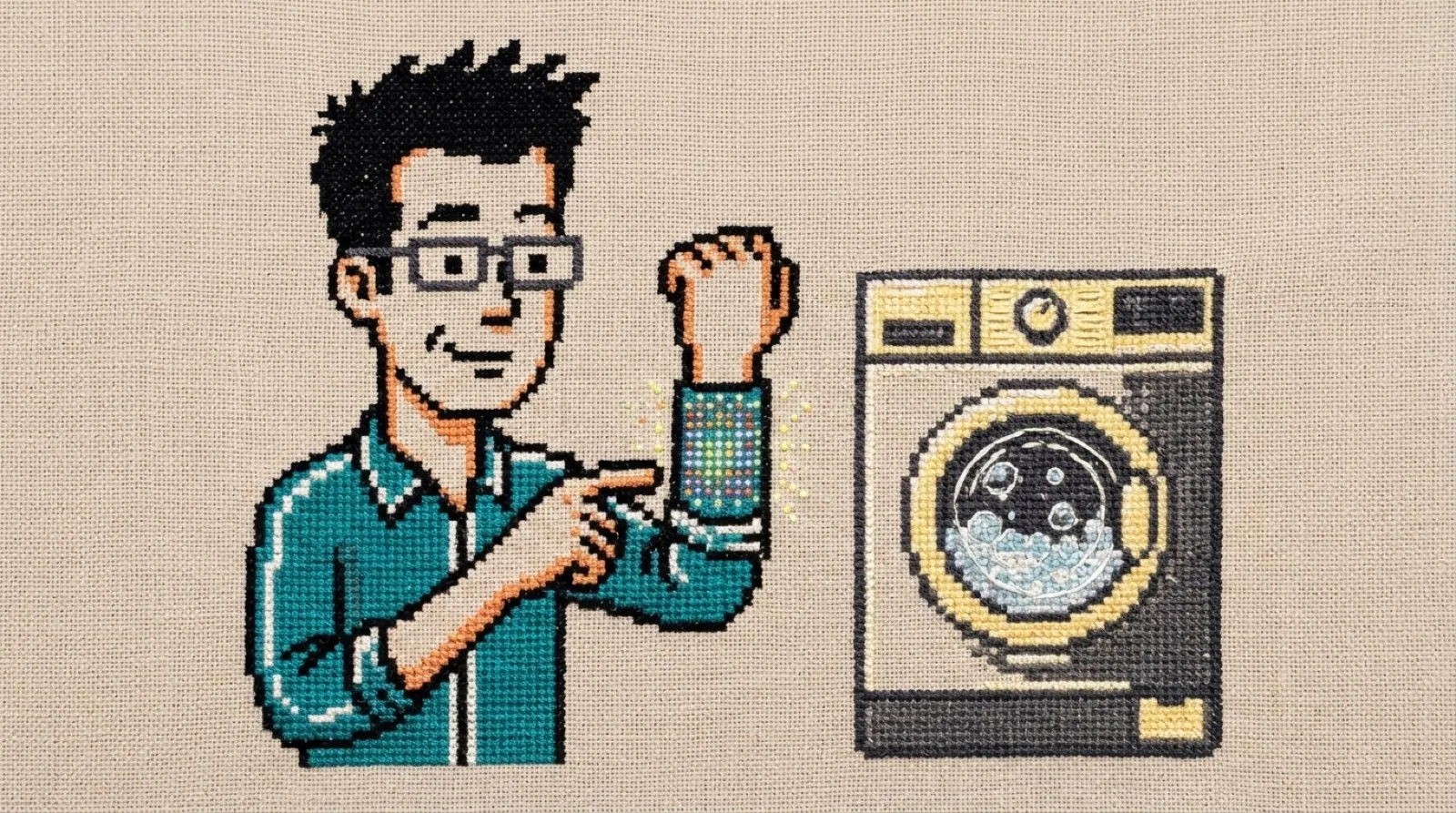
The display sits on the forearm. It measures 168 by 105 millimetres, refreshes at 30 frames per second in 8-bit colour, and connects wirelessly to other devices, NUS says. On the sleeve it ran a calculator, flipped through a photo gallery, played video, worked as a compass, took voice commands and received images over Bluetooth.
The hard part was getting circuitry into something shaped like spaghetti. “A fibre has a one-dimensional, axially symmetric geometry, which makes it difficult to build complex circuitry,” said Assistant Professor Tural Khudiyev, who led the work.
His group’s trick starts with tiny insulated wires. A laser exposes connection points along them, and controlled surface wetting makes molten solder stick only at those points. That’s how they joined “more than 5,000 chips through over 20,000 electrical connections,” then drew the whole LED strip into a multilayer fibre by heating and stretching it. The finished thread is about 1 mm thick and 10 metres long.
Touch lives in the layer beneath the LEDs. Pressing the fibre completes a circuit, and in the team’s Nature paper, “Pressing different axial locations on the pixel fibre (single-point or dual-point touch) produces distinct ADC readings.” One fibre knows roughly where along its length you poked it.
Then they abused it. Brightness and touch response stayed “nearly unchanged after 50 detergent washes in a typical washing machine,” per NUS, and after 1,000 bends around a 5 mm radius. Extra fibres in the garment carry a microphone, a speaker, and sensors for motion, compass heading, temperature and ambient light. Slip the temperature fibre under the arm and the sleeve reads your body temperature.
Neither NUS nor the paper’s public pages say how the sleeve is powered. It talks to devices wirelessly; what it runs on while you wear it through a workday is the number nobody has published yet.
Khudiyev points at health first. “Healthcare is one particularly promising application,” he said, and a sleeve that already reads body temperature through a fibre under the arm is a short walk from a hospital gown that watches a patient. He also made the bigger claim: “garment GUIs could ultimately enable entirely new applications that do not yet exist.”
The likely first stop is narrower. A display you can wash is a work-uniform display: a warehouse picker’s next bin on the forearm, a nurse’s alerts on a cuff. Whether it gets there turns on a power budget that isn’t in the public pages and on how cheaply 5,000 chips per sleeve can be soldered by laser.